What a Watch Render Cannot Tell You
Cover image: Neptune development render showing its disc-based display and case design.
A render is useful when a watch is still an idea. It lets us compare proportions, colors and the way a dial relates to its case. It also gives someone outside the project a much clearer understanding than a page of dimensions.
But a render can look finished long before the watch is ready to make. The image answers visual questions. Engineering drawings, physical samples and test records have other jobs.
Knowing which kind of evidence you are looking at makes a development update much easier to read.
A surface can look right before it exists
Brushing, polished edges and dial texture can all be represented convincingly on a screen. The image does not establish how evenly that brushing will be applied, how cleanly two finishes will meet or how a small edge will feel against a finger.
Lighting matters here. A bright strip across a case can make a chamfer look exceptionally sharp. Dark lighting can conceal an awkward transition. The geometry may be promising, but the physical finish still needs to be seen at ordinary viewing distance and under useful inspection light.
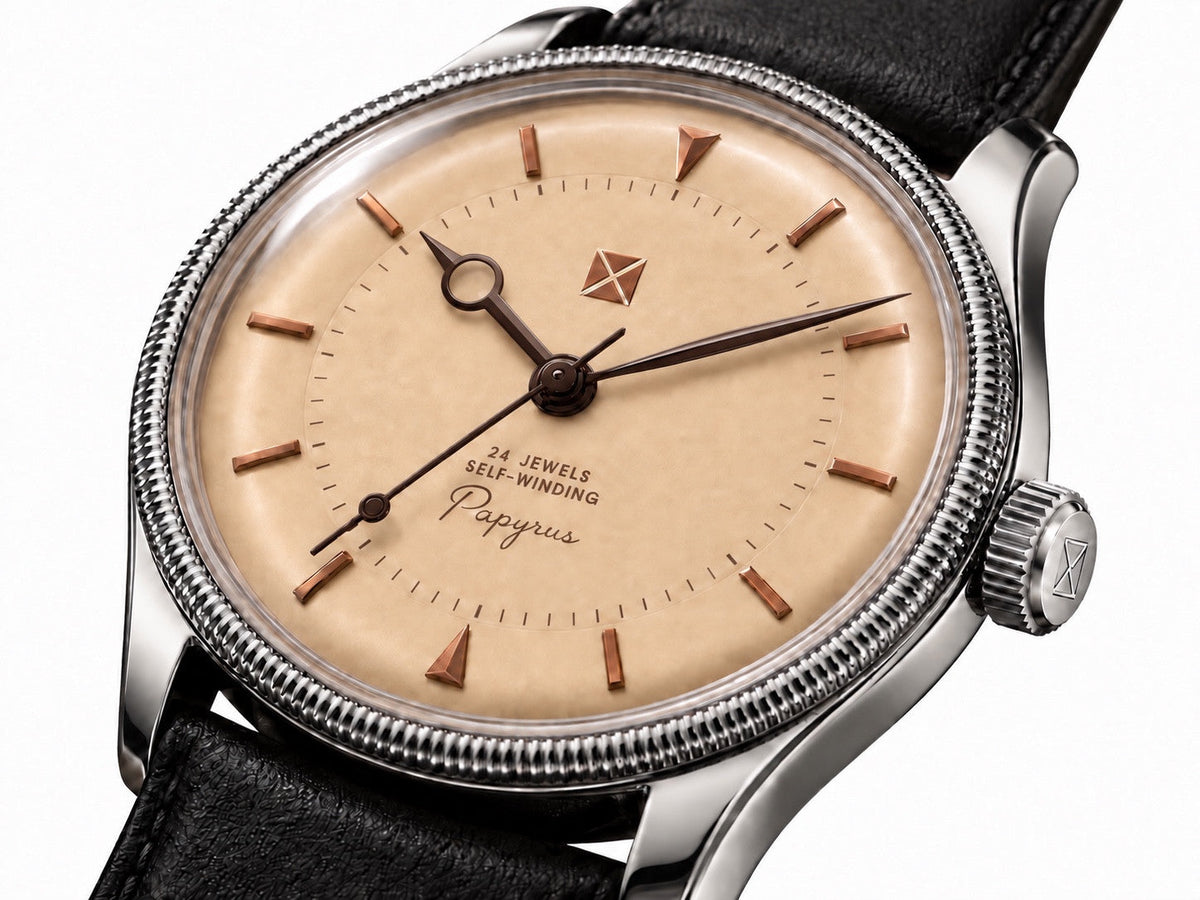
Papyrus is a good example. Its formed dial depends on a transition into a sloping outer ring. The pie-pan dial article explains that geometry; the sample review asks whether it stays clear after color, printing and applied details are added.
Movement can expose what a still image misses
Neptune uses a disc-based display in its current development architecture. The display can look balanced at one time setting while leaving practical questions about overlap, visibility and clearance unanswered.
The assembly needs to be assessed through its operating range. The discs must remain properly spaced and clear surrounding components. Their fit and running behavior require physical evaluation.
Using a known movement does not settle those questions automatically. Miyota lists the 9039 as a three-hand automatic caliber. Neptune's display architecture still has to be engineered and validated around it. A movement's catalog specification cannot serve as a test report for the completed watch.
The same principle applies to a conventional handset. Two hands shown neatly apart in a render will overlap at other times. Their installed heights and contours must accommodate that.
A drawing adds information, with its own limits
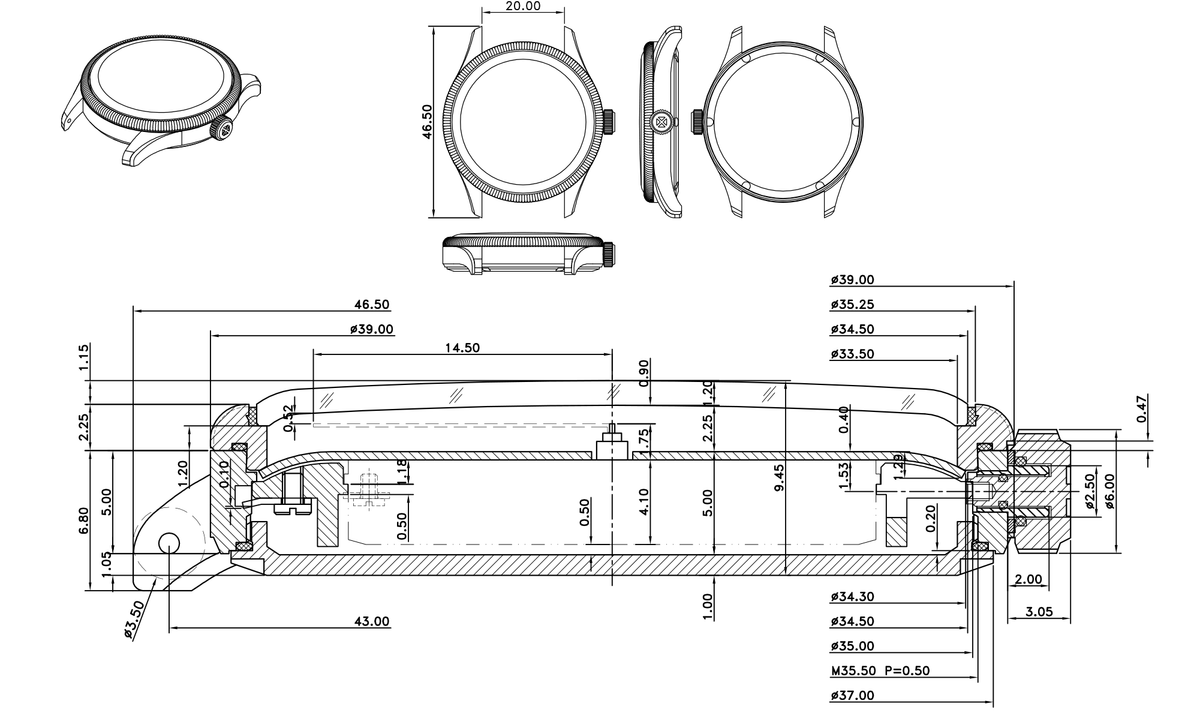
An engineering drawing can specify dimensions, fits, materials and tolerances. A section can show the crystal, dial, movement and caseback in relation to one another. It gives the manufacturer something far more exact to work from.
It still describes the intended part or assembly. The next questions are whether the physical parts match it and whether the assembled watch behaves as intended.
Voyager II currently has a 10–10.5 mm thickness target and a 200 m water-resistance target. Those are development requirements. Neither an attractive rendering nor a dimensioned case drawing is evidence that a finished watch has achieved them.
Water resistance needs an appropriate test of the physical watch. Thickness needs a physical measurement with a clear definition of what is included. Results should be tied to the sample actually examined.
Comfort has to be handled
A wrist render suggests scale. An assembled sample lets us check where the watch contacts the wrist and how it moves. Lug shape, case profile and the first moving bracelet links explain why the fitting stage adds information that a diameter cannot.
A clasp introduces more questions. Is there enough adjustment? Can it be operated comfortably? Does its underside sit neatly? Does the bracelet articulate where it needs to?
Handling the sample answers those questions directly: open the clasp, use its adjustment and let the bracelet curve around the wrist. Each check connects a design choice to the experience of wearing the watch.
From appearance model to production-intent sample
“Prototype” can describe several different things. A non-running appearance model may answer questions about shape. A functional prototype may expose mechanical problems while still using temporary finishes or components. A production-intent sample should represent the proposed materials, construction and finish closely enough to support a meaningful approval decision.
Asking what a sample is meant to prove is more useful than treating the word alone as a milestone. A component sample can answer a narrow question very well without proving the entire watch.
At Cousineau, our launch sequence calls for a production-intent sample, required corrections, Golden Sample approval and a production commitment before preorders. The Golden Sample is the approved physical reference against which production can be compared.
From Golden Sample to a consistent production run
One approved watch does not guarantee that an entire run will match it. Written specifications, agreed inspection criteria and checks on the completed watches remain necessary. A reference sample helps make those discussions concrete.
Production readiness also depends on access to the correct movement, suitable manufacturing capability and a credible production commitment. Our original Voyager and Mainsail projects remain paused while movement and supplier strategy are resolved. The existence of their designs does not resolve those constraints.
For readers following a watch in development, the most useful questions are simple: Is this image a render or a photograph? What stage does the sample represent? Which characteristics have actually been measured or tested? What remains open?
I will continue showing renders because they explain the designs. The useful development story follows each stage: the drawing that specifies it, the sample that establishes the result, the corrections that improve it and the approved reference that guides production.
Follow the designs into physical samples
Join the update list for the next stages of Cousineau watch development.
Get watch updatesFirst published October 6, 2026. Expanded October 6, 2026.