Where Every Millimeter Goes in a Thin Watch
Based on thickness studies from August 6 and September 20, 2026; expanded October 6, 2026.
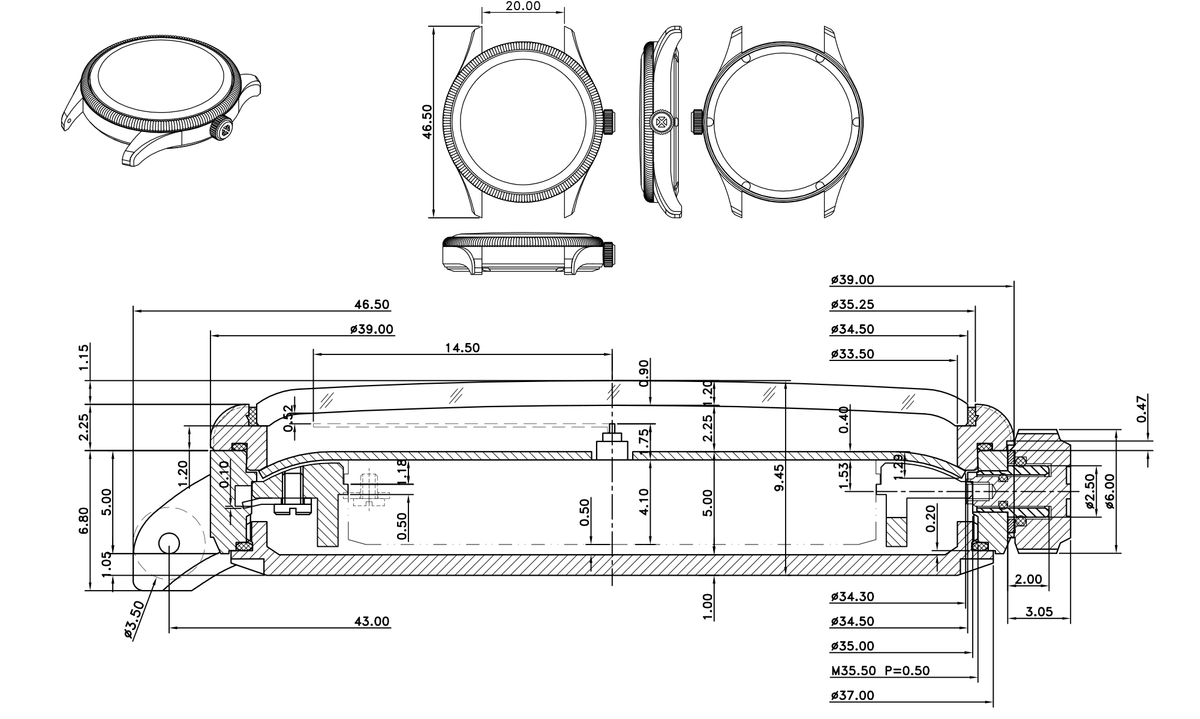
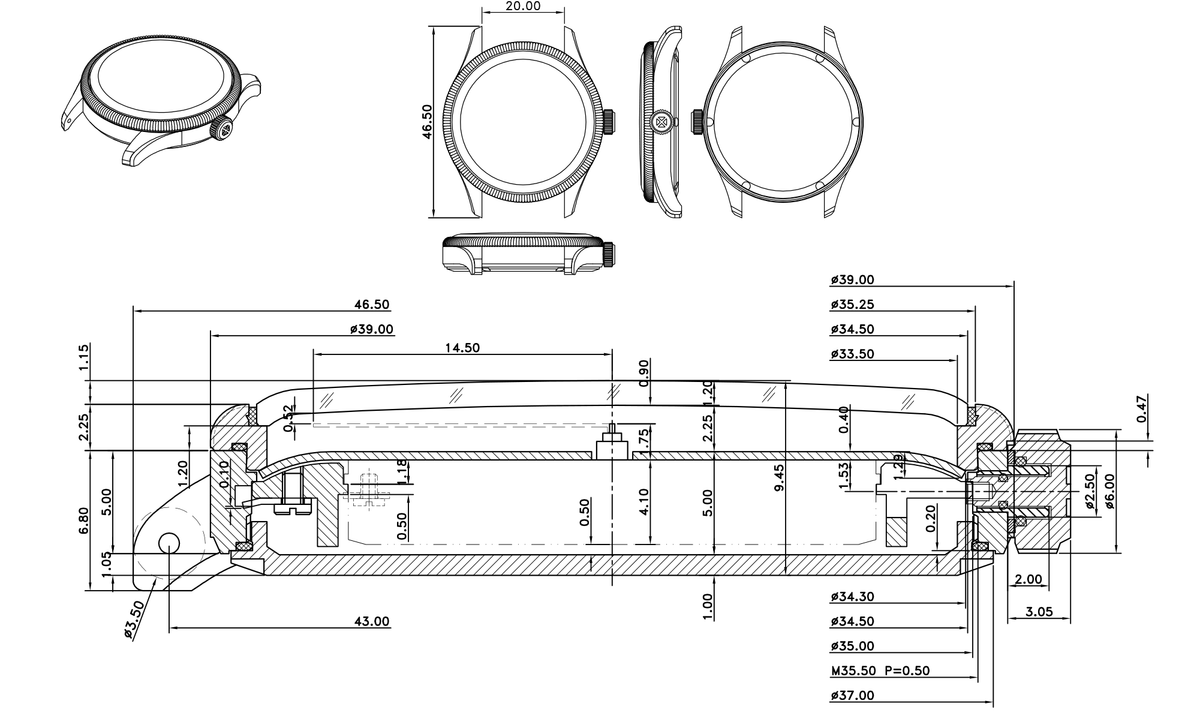
Cover image: Cousineau case development section showing the crystal, dial, movement space and caseback.
A thin automatic watch is a problem in section. Seen from above, the design might look straightforward: a dial, three hands and a narrow bezel. Turn it sideways and every part needs somewhere to go. So does the empty space that allows the watch to run.
That is why a movement's thickness cannot tell you the finished thickness of a watch. It is an important starting point, but the rest of the design still has to fit around it.
Start with the movement drawing
Miyota lists the 9039 at 3.90 mm high. That is the movement specification. It does not include a finished watch's caseback, crystal, dial treatment or the complete space needed by the fitted hands.
The useful next document is the dimensional drawing. An engineer needs the movement's diameter, stem position, mounting arrangement and hand-fitting geometry. Those relationships determine where the crown can sit, how the movement is retained and where the display begins.
Even a simple addition can mislead. Dimensions may be measured from different reference surfaces, and some parts overlap in height. A reliable thickness calculation follows those reference surfaces through the assembly. It cannot be made by adding unrelated numbers from a catalog.

The dial occupies three dimensions
A dial has a physical thickness, a mounting position and a surface profile. Applied markers stand above it. A sloping outer ring changes the distance between the dial and a passing hand.
Papyrus makes that especially relevant. Its physically formed pie-pan dial has a flatter center and sloping outer annulus. The current development specification is 9.45 mm overall, using the Miyota 9039. The section has to fit that dial profile, the hands and the crystal within one envelope.
A convincing face-on drawing does not settle this. The section must show where the dial actually sits and which part of the display comes closest to the moving hands. Raising the hands to clear a marker can consume space beneath the crystal. Lowering the dial can affect its support and relationship with the case opening.
Moving parts need room to move
Hand clearance is easy to overlook because it is mostly invisible in a finished watch. The hour hand must clear the dial and its furniture. The minute hand must clear the hour hand. The seconds hand, where fitted, needs its own working space.
That clearance has to remain adequate throughout the hands' rotation. A single attractive setting, with the hands separated, cannot establish it. Hand length, contour and installation height all matter.
Miyota's 9039 specification sheet explicitly makes clearance dependent on the crystal, case structure and hand length. That is a useful reminder: a movement choice does not supply a universal clearance allowance for every watch built around it.
Manufacturing also introduces variation. Parts and assembly positions have tolerances. The design must leave enough margin for an acceptable combination of those variations, rather than working only when every component lands exactly at its nominal dimension.
The crystal and caseback complete the enclosure
The crystal's outer profile affects overall height, while its inner profile affects the room available to the hands. A domed crystal can provide useful space near the center, but its edge and seating arrangement still need to fit the case.
Below the movement, the caseback needs a secure closure and sufficient room for the movement's moving parts. Around the assembly, the crystal seat, crown and caseback interfaces must accommodate the chosen sealing arrangement. Gaskets have working compression requirements; they are not empty gaps that can simply be removed to save height.
That makes sealing part of the height budget from the beginning. Leaving the correct room for the gasket and its supporting surfaces is part of building a thin watch that remains dependable in use.
The same caliber can lead to different watches
Our current Outrigger development specification combines a 39 mm diameter, two-piece case, layered dial and 9.9 mm thickness with the 9039. Voyager II is being engineered around the same caliber at 40 mm, with a 10–10.5 mm thickness target.
Those different design envelopes reflect different requirements. Outrigger has a 10 ATM water-resistance target; Voyager II has a 200 m target. Their case, display and sealing requirements must be resolved as complete assemblies. These dimensions and ratings are development targets awaiting physical validation.
Read the side profile as well as the number
When comparing thin watches, ask whether the quoted thickness includes the crystal and the lowest point of the caseback. Then look at a true side view. The height of the visible case flank, the crystal's projection and the way the lugs turn toward the wrist all influence how the watch presents itself.
The reward for resolving the section is a watch with room to run properly inside a comfortable profile. For the choice that starts that process, read how I approach movement architecture, reliability and service.
Follow the next development step
See Papyrus and join its update list as the design moves from drawings toward physical samples.
Get Papyrus updatesFirst published October 6, 2026. Expanded October 6, 2026.