Choosing a Movement: Thickness, Reliability and the Life of a Watch
Based on movement-selection notes begun in May 2026; expanded October 6, 2026.
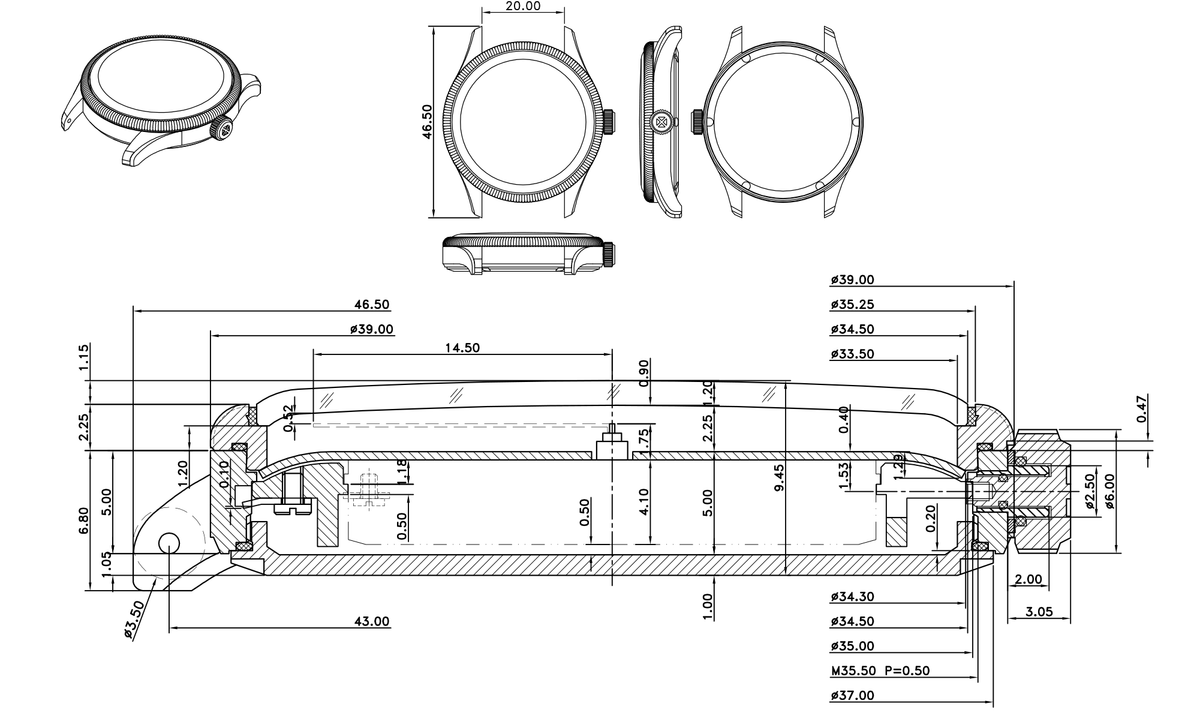
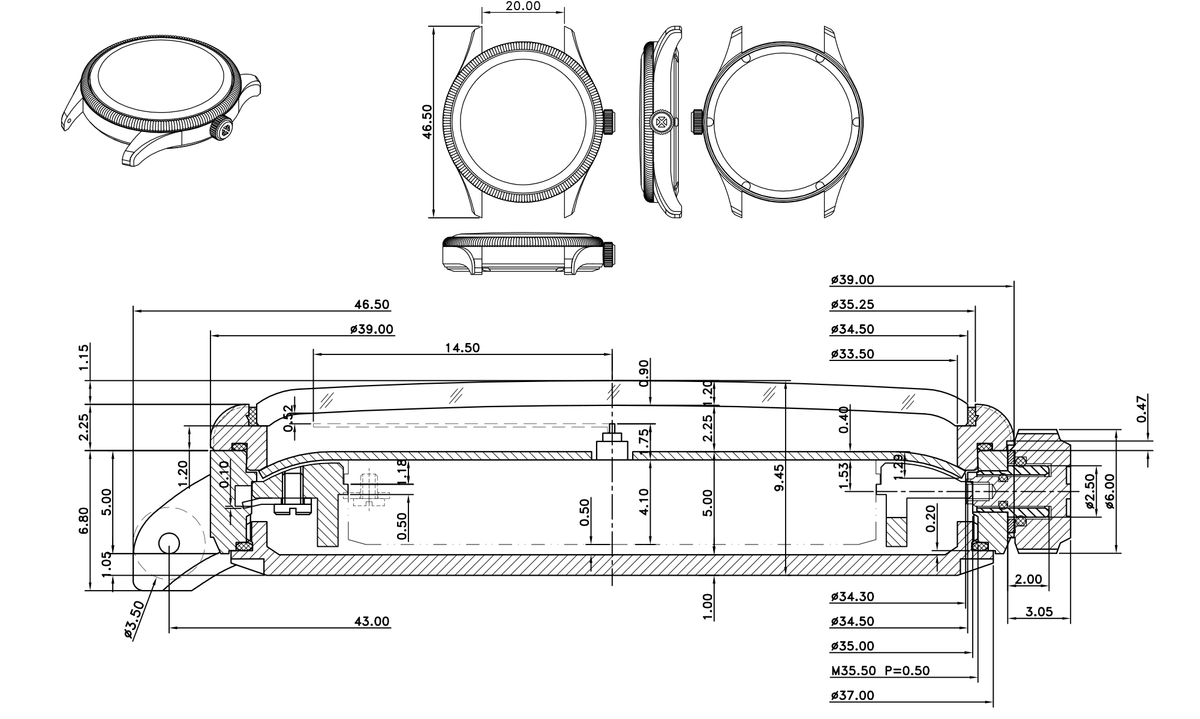
Cover image: Cousineau case development drawing showing the movement envelope and surrounding clearances.
The movement is usually one line on a watch’s specification sheet. During development, it reaches into almost every part of the object: where the hands sit, how deep the dial can be, where the crown enters the case, how much room remains beneath the crystal, and how the watch might be repaired years from now.
That makes movement selection one of my earliest design decisions. I want Cousineau watches to be reliable in use, practical to maintain and worth keeping long enough to pass on. The movement has to support those goals while leaving room for the depth, proportions and unusual details that give each watch its character.
The movement sets the architecture
A movement's quoted height describes the caliber. Around it, the watch still needs a dial, hands or other display elements, a crystal, a caseback and working clearances. The detailed section is the subject of where every millimeter goes in a thin watch.
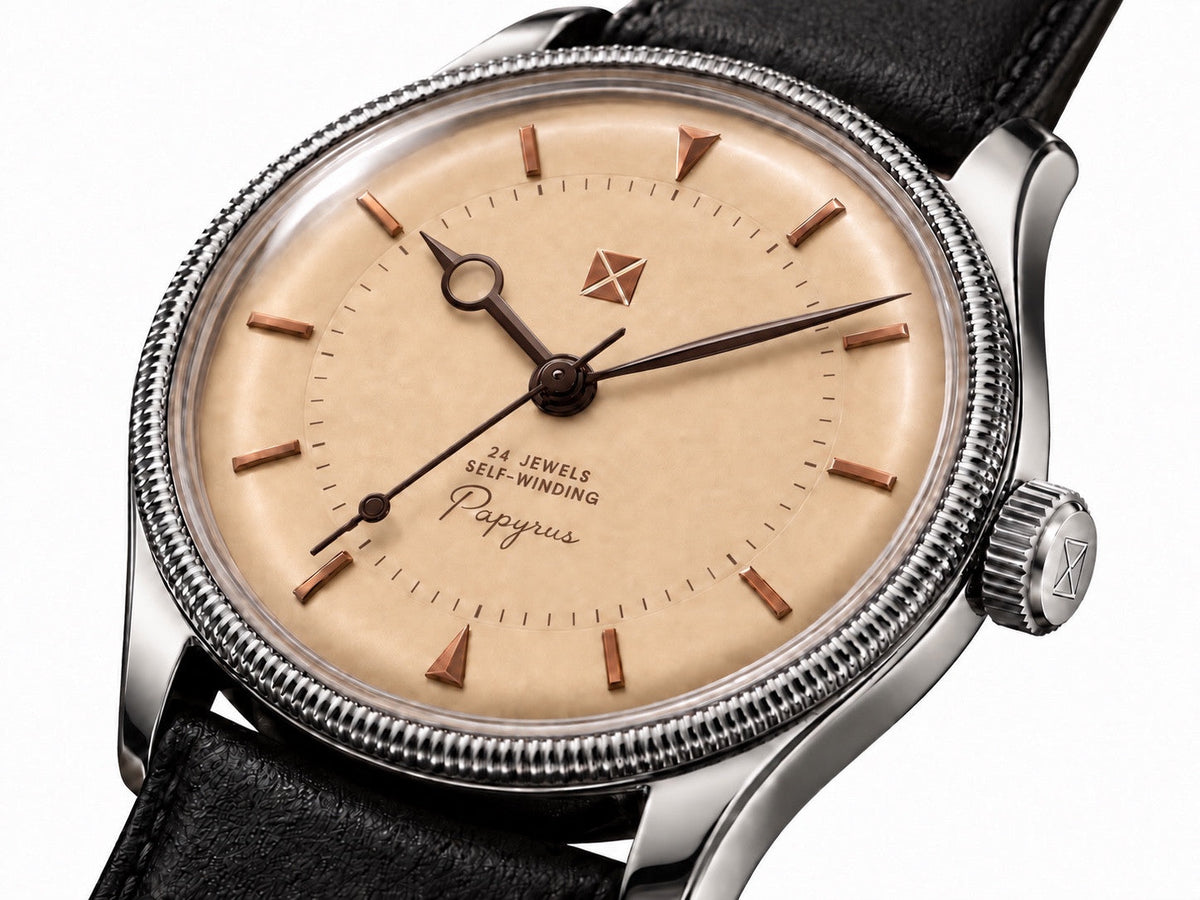
The bigger choice here is what the movement allows the watch to be. Papyrus calls for a formed dial; Outrigger has a sloped chapter ring and recessed center; Neptune adds rotating display elements. The caliber has to suit the intended display and leave space for it.
The crown introduces another constraint. Its stem has to meet the movement at the correct height and orientation. Changing the caliber can require a different movement holder, dial attachment, hand fittings, stem position and case geometry. Two movements with similar diameters can still require substantially different watches around them.
What a thinner movement makes possible
The Miyota 9039 illustrates why this discussion becomes practical quickly. Miyota lists a movement height of 3.90 mm, automatic and manual winding, a stop-seconds function and approximately 42 hours of running time. It is a three-hand, no-date platform. Those are useful starting conditions for a compact watch with a deliberately uncluttered display. Miyota’s current specifications give the dimensions and functions that make it useful for that design direction.
The Sellita SW260-1 originally selected for Voyager and Mainsail has a different architecture. Sellita lists a height of 5.60 mm and a small-seconds display at six o’clock. The 1.70 mm difference in movement height is meaningful, but the small-seconds layout is meaningful too. It shapes the dial and gives those watches part of their character. See Sellita’s caliber catalog.
Replacing the SW260-1 with a 9039 would therefore involve more than gaining space. A central-seconds movement does not produce a small-seconds display just because the dial has a circle at six. Preserving that display would require a compatible movement or additional engineering. The decision has to be made at the level of the whole watch.
In the current development program, Papyrus, Neptune and Outrigger use the 9039, while Voyager II is being engineered around it. Voyager and Mainsail are paused while we review their movement and supplier path. As explained in the October development update, reliable SW260-1 sourcing for our projects has been a constraint. That describes our manufacturing situation; it is not a claim that the caliber is unavailable everywhere.

Reliability extends beyond the caliber
A good movement needs a good installation. The dial and hands must fit correctly. The crown must operate cleanly. An unusual display must work throughout its travel. A case must protect the assembly. Getting those relationships right is how the caliber’s qualities reach the person wearing the watch.
Our planned incoming inspection process includes functional checks, timing tests for mechanical watches and dry pressure tests for water-resistant models. Timing inspection and regulation are separate things: measuring a watch does not mean we have adjusted it. Prototype approval also has to address the actual object, including display clearances, winding, setting and the fit of the components around the movement.
That is why a slightly thicker, properly resolved watch can be a better outcome than an impressive thickness claim with insufficient working clearance. Thinness is valuable when the watch remains comfortable, dependable and practical to maintain.
How quartz changed the question
The history of movements helps explain why nationality alone is such an incomplete way to judge one. On December 25, 1969, Seiko introduced the Quartz Astron 35SQ, the first commercially available quartz wristwatch. It was initially a costly technological achievement, priced in the territory of a car. Quartz’s later association with inexpensive watches can obscure how ambitious that early development was. The Seiko Museum’s account follows the long work of turning large quartz clocks into wristwatches.
As electronic timekeeping spread, it changed expectations for accuracy, manufacturing and price. The upheaval coincided with economic crises. The Federation of the Swiss Watch Industry records a fall from about 90,000 Swiss watch-industry employees in 1970 to just over 30,000 in 1984. Those figures describe a profound industrial contraction. The federation’s historical overview also describes the subsequent recovery of mechanical watchmaking.
Consolidation was part of the response. ASUAG and SSIH came together in 1983 in the group that later became Swatch Group. The Swatch itself, introduced that year, was a Swiss quartz watch built around a radically simplified, highly automated production approach. Swatch Group’s history makes clear that electronic watchmaking was part of the Swiss recovery, alongside the renewed appeal of mechanical watches.
The result was a more complicated industry than a contest between two flags. Swiss companies make quartz movements. Japanese companies make mechanical movements. Precision, industrial scale, craft and inventive engineering exist in both traditions.

Why a Japanese movement belongs here
Miyota’s origins reach back to a Citizen movement factory established in 1959. The Miyota brand launched in 1980, and its history includes both high-volume quartz production and decades of mechanical development. The thin 90 Series sits within that industrial background. Miyota’s own history gives useful context for the name on the specification sheet.
For us, the appeal of a movement such as the 9039 is concrete: its dimensions, display architecture and winding functions fit several watches we want to make. Supplier access, technical documentation, assembly quality and the future service path all matter as well. There is no useful shortcut in assuming that every caliber from one country is superior to every caliber from another.
Designing for the next owner
Passing a watch on begins with making something people want to keep. It also asks a practical question: what will a watchmaker need when the watch eventually requires attention?
Mechanical service can include disassembly, cleaning, lubrication, adjustment and replacement of worn components. Quartz watches can also be maintained and repaired; they deserve the same serious consideration of parts and support. Seiko’s service explanation for mechanical and quartz watches describes both approaches. The absence of a battery does not make a mechanical watch maintenance-free.
An established caliber and accessible documentation are useful foundations. They do not guarantee perpetual parts availability. A proprietary display, damaged crown, unusual crystal or discontinued case component can complicate repair even when the base movement is familiar.
I choose with that longer ownership in mind: a movement suited to its job, enough room for it to work properly and a realistic route to service. Care, maintenance and continuing support all contribute to passing a watch on. Those practical choices belong in the design from the beginning.
Follow Cousineau watch development
Join the update list to follow the designs, movement choices and next development steps.
Get watch updatesFirst published October 6, 2026. Expanded October 6, 2026.